
Cost
Texas Mini Split Cost Guide 2026
What ductless mini split installation actually costs in Texas in 2026 — single-zone through whole-home, plus the line items that move the number.
The short answer
A single-zone mini split costs $2,000 to $5,500 installed in Texas in 2026, covering equipment and labor. A dual-zone system covering two rooms runs $4,000 to $9,000, a three-to-four-zone system $6,500 to $11,000, and a whole-home ductless replacement $10,000 to $14,500.
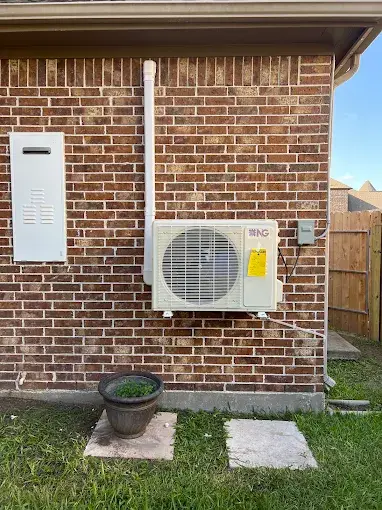
What you actually pay
Most Texas mini split content quotes a national average and leaves it there. Here are real installed prices — equipment, labor, line set, refrigerant, and commissioning included.
| System type | Typical use case | Estimated installed cost |
|---|---|---|
| Single-Zone (12k BTU) | A hot bonus room over the garage, a home office, or a converted space | $2,000 – $5,500 |
| Dual-Zone (2 heads) | A primary suite plus a home office | $4,000 – $9,000 |
| Multi-Zone (3–4 heads) | Zoned cooling for an older home with no duct space | $6,500 – $11,000 |
| Whole-Home Replacement | Replacing central AC entirely | $10,000 – $14,500 |
Three things decide where you land inside a range: capacity (a 9,000 BTU bedroom unit sits near the bottom, a 36,000 BTU unit near the top), equipment quality, and installation complexity — a new dedicated 240V circuit, a long line-set run, or an awkward condenser location all move you up.
Why premium equipment sometimes shows a lower SEER2
This confuses people, so it is worth addressing directly. Premium units sometimes carry a lower SEER2 rating than budget ones. That looks backwards.
SEER2 is a seasonal cooling efficiency rating measured under specific test conditions. It says nothing about how well a unit sustains capacity in extreme heat, how much output it retains at low outdoor temperatures in heating mode, how quiet it is, or how well the manufacturer supports parts a decade out.
Premium manufacturers frequently optimize for sustained real-world capacity and durability rather than peak rated efficiency. A unit that holds full output at 105°F ambient is doing something a test-bench SEER2 number does not capture.
The practical guidance: for a garage, guest room, or space you use intermittently, the entry option is the right economic call. For a primary bedroom or living room you will run daily for fifteen years, the step up is defensible.
Multi-zone pricing
Multi-zone systems put two to eight indoor heads on one outdoor condenser. Head sizes, line-set routing, and condenser placement move the number within these ranges.
| Configuration | Typical coverage | Estimated installed cost |
|---|---|---|
| 2 zones | Living area + bedroom | $4,000–$9,000 |
| 3–4 zones | Living area + 2–3 bedrooms | $6,500–$11,000 |
| Whole-home replacement | Replacing central AC entirely | $10,000–$14,500 |
The dividing line between separate single-zone systems and one multi-zone system falls around three rooms. Below that, separate systems are often competitive and give you redundancy. Above it, multi-zone usually wins on cost and puts one unit outside instead of four.
What moves your price
System type and capacity. The two biggest factors, and the ones that set the range above.
Electrical work. Roughly $550 for a dedicated circuit. If your panel is full or you have 100-amp service — common in pre-1970 Texas housing — a subpanel or service upgrade adds $1,500 to $4,000. Have this checked early.
Line-set length. A standard installation includes a line set of typical length. A condenser 40 feet from the indoor head costs more in material and, past certain lengths, requires a larger unit to maintain capacity.
Mounting type. Wall-mounted heads are standard and cheapest. Floor-mounted units cost modestly more. Ceiling cassettes cost considerably more and require adequate ceiling cavity.
Access difficulty. A second-story install requiring lift equipment, a condenser location needing a long conduit run, or an attic with no walking room all add labor.
Elevated condenser mounting. In flood-prone areas — parts of Houston, Katy, Pearland — mounting the condenser on brackets or a stand adds $150 to $400 and is well worth it.
Removing old equipment. Pulling a window unit is free. Removing an evaporative cooler and properly closing and flashing the roof opening runs $300 to $800, and is the most commonly underestimated line item in El Paso.
What should already be included
If any of these appear as a surprise add-on, ask why:
- Line set, refrigerant, and condensate drain
- Wall penetration and sealing
- Outdoor pad or wall bracket
- System evacuation and vacuum before charging
- Startup, commissioning, and homeowner walkthrough
- Permit filing and inspection coordination
- Manufacturer warranty registration
The vacuum step deserves emphasis. Pulling a proper vacuum on the refrigerant lines removes moisture and non-condensables before charging. Skipping or rushing it is invisible on install day and destroys compressors within a few years. It is the single most common corner cut on a cheap installation.
Rebates in 2026
The federal 25C Energy Efficient Home Improvement Credit — which offered up to $2,000 on a qualifying heat pump — expired December 31, 2025 under the One Big Beautiful Bill Act. It is not available for systems installed in 2026. Be skeptical of any contractor or website still advertising it.
Utility rebates remain, and they vary substantially by provider:
| Utility | Coverage | Typical rebate |
|---|---|---|
| Oncor | DFW, Waco, Tyler, Lubbock | Up to $600 per heat pump |
| CenterPoint | Greater Houston | Up to $500 per heat pump |
| CPS Energy | San Antonio / Bexar County | $100–$275 per ton |
| Austin Energy | City of Austin only | Up to ~$3,000, whole-home projects |
The most common mistake is assuming your metro’s big-name utility serves you. Austin Energy stops at the Austin city limits — Round Rock, Cedar Park, and Pflugerville are Oncor or co-op territory. Municipal utilities in Georgetown, New Braunfels, and Boerne run their own programs entirely. Check a recent bill.
See the full rebates guide for details and requirements.
Getting a comparable quote
Three quotes are only useful if they cover the same scope. Ask each contractor to specify:
- Exact model numbers for indoor and outdoor units
- Whether a load calculation was performed, and its result
- Whether a dedicated circuit is included or excluded
- Line-set length included and cost per foot beyond it
- Permit filing — included or your responsibility
- Warranty terms on equipment and on labor, stated separately
A quote that is $800 cheaper because it omits the permit and assumes an existing circuit is not cheaper.
What this costs in your city
Installed pricing is broadly consistent across Texas metros — labor rates vary modestly, but equipment tier and unit size dominate. Local pages cover permitting, rebates, and climate specifics:
Dallas · Houston · San Antonio · Austin · Fort Worth · El Paso
Or see the full pricing page for the complete tables, and single-zone systems for what a one-room installation involves.
About the author
John Zoch
John Zoch is a partner at Get Mini Split Quotes, the veteran-owned Houston company that matches Texas homeowners with TDLR-licensed, EPA-certified ductless installers. He works with homeowners and licensed installers across 28 Texas cities, from Gulf Coast humidity problems to Panhandle-edge freeze performance. He writes about what ductless systems actually cost and, just as often, where they are not the right answer.
Published . Last updated . Pricing and program information change — figures are current as of the last update and are estimates, not quotes.
Keep reading
- What Size Mini Split Do I Need? A Texas Sizing Guide
How many BTUs you need by room size, the Texas factors that move that number 30–50%, and why oversizing is the more expensive mistake in Gulf Coast humidity.
- Do You Need a Permit for a Mini Split in Texas? City-by-City Guide
Yes, most Texas cities require a permit for a mini split. What each permit covers, what the inspector checks, and the rules in all 28 Texas cities we serve.
- Texas Mini Split Rebates & Tax Credits in 2026
The federal 25C credit expired at the end of 2025. Here is what Texas homeowners can actually claim in 2026, utility by utility, with the requirements that disqualify people.