
Permits
Do You Need a Permit for a Mini Split in Texas? City-by-City Guide
Yes, most Texas cities require a permit for a mini split. What each permit covers, what the inspector checks, and the rules in all 28 Texas cities we serve.
The short answer
Yes — in most Texas cities a new mini split requires a mechanical permit, plus an electrical permit if a new dedicated 240V circuit is run. Your licensed installer pulls both and coordinates the inspection, and the filing is included in the $2,000–$5,500 installed price rather than billed to you separately. The requirement comes from the city or county, not the state, so it varies by address.
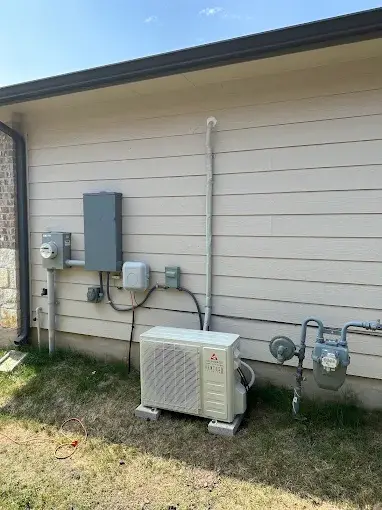
The short version, then the detail
A ductless mini split is a permanent mechanical system with a refrigerant circuit and, usually, a new 240V branch circuit. Every Texas jurisdiction with active code enforcement treats that as permitted work.
Two things follow that homeowners often get wrong:
It is your contractor’s job, not yours. A licensed installer pulls the permit, schedules the inspection, and closes it out. You should not be filing anything.
“No permit needed” is a red flag, not a discount. A contractor offering to skip it is telling you they either are not licensed to pull one, or would rather not have their work inspected. Both are reasons to get a different quote.
What permits a mini split actually triggers
Most homeowners expect one permit. A typical installation touches two or three.
| Permit | What it covers | When it applies |
|---|---|---|
| Mechanical | Refrigerant line set, condensate routing, equipment mounting, pressure and vacuum testing | Essentially always |
| Electrical | New 240V branch circuit, breaker sizing, outdoor disconnect | Whenever a dedicated circuit is run — most installs 18,000 BTU and up |
| Building | Wall penetration, condenser pad or wall bracket, structural mounting | Some jurisdictions, usually for larger or roof-mounted equipment |
A 9,000 or 12,000 BTU unit running on an existing 115V circuit may only need the mechanical permit. Anything larger almost certainly needs electrical too, because it requires its own 208/240V circuit.
What the inspector is actually checking
Worth knowing, because these are the same things that determine whether your system lasts fifteen years or fails in three.
- Refrigerant line set — properly flared, supported, and protected where it passes through the wall
- Evacuation and pressure test — that a deep vacuum was pulled before charging. Moisture left in the circuit forms acids that destroy the compressor over two to five years, and it is invisible on install day
- Condensate routing — continuous fall, no traps, terminating somewhere sensible rather than against your foundation
- Electrical — correct breaker size, proper conductor gauge, an accessible outdoor disconnect within sight of the condenser
- Equipment mounting — that the condenser pad or bracket actually carries the load
- Clearances — adequate airflow around the outdoor unit
The inspection is not bureaucratic theatre. It catches exactly the shortcuts that make a cheap installation expensive later.
What it costs you
Nothing directly. Permit filing and inspection coordination are part of the installed price:
| System | Installed cost | Permits |
|---|---|---|
| Single-Zone (12k BTU) | $2,000 – $5,500 | Included |
| Dual-Zone (2 heads) | $4,000 – $9,000 | Included |
| Multi-Zone (3–4 heads) | $6,500 – $11,000 | Included |
| Whole-Home Replacement | $10,000 – $14,500 | Included |
Municipal permit fees themselves vary by city and by system size, and they are the contractor’s line item, not a surprise added to your invoice. If a quote lists a separate permit charge, ask what it covers — that is a fair question, not a rude one.
See the full pricing guide for what moves you inside each range.
The rules where you live
The requirement comes from your city or county, not the State of Texas, so it genuinely differs by address. Each of our city pages covers the local permitting office, the utility rebate that actually applies there, and climate-specific sizing.
Dallas–Fort Worth. Dallas · Fort Worth · Plano · Frisco · McKinney · Arlington · Carrollton · Denton · Garland · Irving · Richardson
Greater Houston. Houston · Katy · Sugar Land · The Woodlands · Pearland · Cypress · Spring
Greater San Antonio. San Antonio · New Braunfels · Schertz · Boerne
Greater Austin. Austin · Round Rock · Cedar Park · Georgetown · Pflugerville
West Texas. El Paso
Four situations that catch people out
1. You are not in the city you think you are
This is the single most common surprise, and it is worse in Texas than most states because so much growth happened outside municipal boundaries.
The City of Katy limits are much smaller than the area people call Katy — most Katy-addressed homes are actually unincorporated Harris, Fort Bend, or Waller County. Cypress is not an incorporated city at all; there is no Cypress city hall. Spring straddles the Harris–Montgomery county line. The Woodlands is a township, not a city, and permits through Montgomery County.
County requirements are generally lighter than municipal ones, but licensed work is still required. Your contractor should confirm jurisdiction before filing anything.
2. HOA approval is not a permit
They are separate processes, enforced by different bodies, and you may need both.
The city cares about whether the work is safe and to code. Your HOA cares about whether the outdoor condenser is visible from the street and whether it is screened. Passing inspection does not mean your association is satisfied, and association approval does not substitute for a permit.
HOA coverage is near-universal in Frisco, Sugar Land, Plano, and the master-planned communities around Cypress and Katy. Submit for architectural approval before scheduling installation — relocating a condenser afterward is money spent for nothing.
3. Historic districts add a review layer
If your home is in a designated historic district, exterior equipment placement may need review on top of the standard permit. The indoor head is not the issue; the outdoor condenser is.
This affects a lot of desirable neighbourhoods: Swiss Avenue and Munger Place in Dallas, Fairmount in Fort Worth, King William and Monte Vista in San Antonio, Hyde Park and Clarksville in Austin, Oak-Hickory in Denton, the downtown squares in McKinney and Georgetown, and the Hill Country Mile in Boerne.
The usual resolution is straightforward: put the condenser on a rear or side elevation out of view from the street, screen it with fencing or planting that does not block airflow, and use line-set covers painted to match the trim. Raise it during the quote rather than after equipment is ordered. Older homes covers the preservation-friendly approach in more detail.
4. Rental property has less room for error
Unpermitted mechanical work on a rental is a problem at re-inspection, at resale, and in any insurance claim. Arlington operates a rental registration and inspection program specifically, and unpermitted HVAC is a recurring finding there.
The homestead exemption that lets a Texas homeowner do some work on their own residence does not extend to property you rent out.
What actually happens if you skip it
Not much, until it matters. Then several things at once:
At resale. Unpermitted mechanical work turns up in the buyer’s inspection and gets negotiated against you — usually at more than the permit would have cost. Some buyers ask for retroactive permitting, which means opening up finished work.
In an insurance claim. If a fire or water loss traces back to the installation, an unpermitted system gives the carrier a reason to look harder at the claim.
On the manufacturer warranty. Most manufacturers require professional installation. An unpermitted job by an unlicensed installer is difficult to defend if a compressor fails in year four.
With the city. Some jurisdictions can require the work be exposed for inspection after the fact.
None of this is likely on any given job. All of it is avoidable for free, since the filing is already in the price.
How to confirm your installer actually pulled it
Three questions, asked before work starts:
- “Which permits are you pulling, and under whose licence?” A licensed contractor answers instantly. Ask for the TDLR licence number.
- “Will you schedule the inspection and send me the sign-off?” You want the closed permit in writing, not just a promise.
- “Is my address in the city or the county?” If they have not checked, they may be about to file in the wrong jurisdiction.
Every installer in our network holds a current TDLR licence, EPA Section 608 certification, and active liability insurance — verified before they join. Permitting is part of the job, not an upsell.
Related reading
- Texas Mini Split Cost Guide 2026 — what a system costs, by type
- DIY vs Professional Installation — what Texas law actually requires, and where the homestead exemption stops
- Texas Rebates & Tax Credits — utility programs, and why the federal 25C credit no longer applies
- Single-zone systems — what a one-room installation involves
Permit requirements are set by individual Texas cities and counties and change without notice. This is general guidance, not legal advice. Confirm current requirements with your local building department, or let your licensed installer do it — that is what they are for.
About the author
John Zoch
John Zoch is a partner at Get Mini Split Quotes, the veteran-owned Houston company that matches Texas homeowners with TDLR-licensed, EPA-certified ductless installers. He works with homeowners and licensed installers across 28 Texas cities, from Gulf Coast humidity problems to Panhandle-edge freeze performance. He writes about what ductless systems actually cost and, just as often, where they are not the right answer.
Published . Last updated . Pricing and program information change — figures are current as of the last update and are estimates, not quotes.
Keep reading
- Texas Mini Split Cost Guide 2026
What ductless mini split installation actually costs in Texas in 2026 — single-zone through whole-home, plus the line items that move the number.
- What Size Mini Split Do I Need? A Texas Sizing Guide
How many BTUs you need by room size, the Texas factors that move that number 30–50%, and why oversizing is the more expensive mistake in Gulf Coast humidity.
- Texas Mini Split Rebates & Tax Credits in 2026
The federal 25C credit expired at the end of 2025. Here is what Texas homeowners can actually claim in 2026, utility by utility, with the requirements that disqualify people.