
Comparison
Mini Split vs Central AC in Texas: Which Is Actually Better?
An honest comparison for Texas homes — installed cost, duct losses, zoning, humidity, and the specific cases where central AC is still the better buy.
The short answer
For a Texas home with sound ductwork in decent condition, a high-efficiency central system is usually the better value. For a home whose ducts run through a 140°F attic and leak — which describes a large share of Texas housing — ductless eliminates a 20–30 percent loss that central AC cannot. The state of your ductwork decides it, not the equipment type.
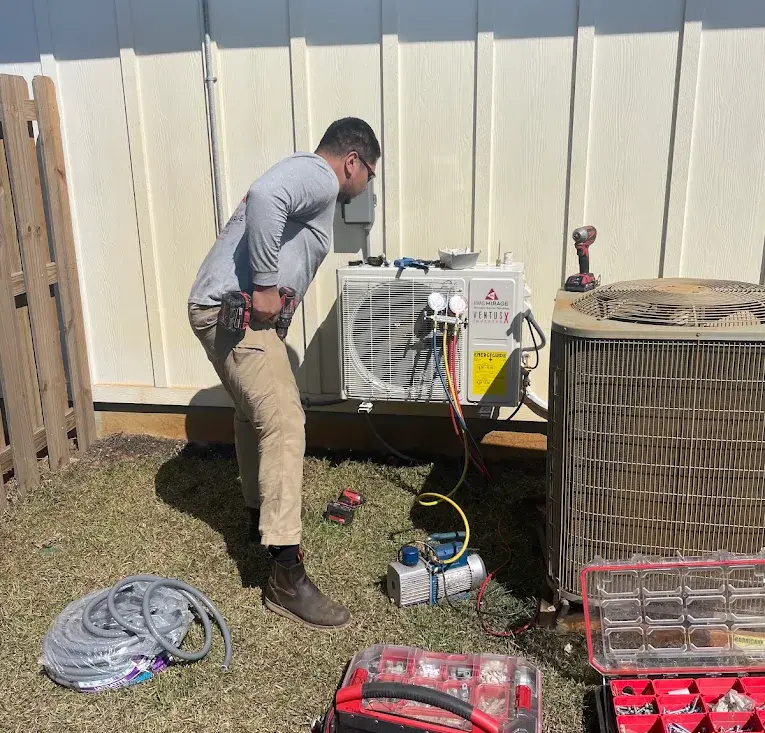
The honest version of this comparison
Most articles on this question are written by someone selling one of the two. The real answer is that it depends on one measurable thing: the condition of your existing ductwork.
If your ducts are sealed, correctly sized, and ideally in conditioned space, central air is efficient and a high-efficiency replacement is usually the better economic choice. If your ducts are forty years old, undersized, and running through a Texas attic that hits 140°F in July, you are losing a large fraction of what you pay to condition — and no new condenser fixes that.
That is a question you can answer with a test rather than an opinion.
Head-to-head
| Ductless mini split | Central AC | |
|---|---|---|
| Installed cost, whole home | $10,000–$14,500 (est.) | $12,000–$22,000 |
| Installed cost, one room | $2,000–$5,500 | Not practical alone |
| Distribution loss | None | 20–30% typical in TX attics |
| Room-by-room control | Yes, standard | Only with zoning dampers |
| Efficiency rating | 18–24 SEER2 | 14–20 SEER2 |
| Visible indoor equipment | Yes, one head per room | No, flush registers |
| Central filtration | Per-unit washable filters | Whole-house media filter |
| Whole-house dehumidifier | Not directly compatible | Can be integrated |
| Simultaneous heat + cool | No, on shared condenser | No |
| Install disruption | Low — 3“ hole per zone | High if re-ducting |
| Phaseable over years | Yes | No, all-or-nothing |
| Typical service life | 15–20 years | 12–18 years |
The duct loss argument, with numbers
This is the core of the case for ductless in Texas, and it deserves specificity rather than hand-waving.
Studies of Texas housing consistently find duct systems in unconditioned attics losing 20 to 30 percent of conditioned air through leakage at joints and thermal transfer through duct walls. Texas attics reach 130 to 150°F in July. Even well-insulated ducts lose capacity across their length in that environment; leaking ducts lose conditioned air outright.
At 25 percent loss you pay for four units of cooling and receive three, every hour the system runs, for the life of the equipment.
A ductless system has no distribution path. The evaporator coil is in the room being conditioned. The loss is zero by construction — not reduced, absent.
Add zoning on top. A central system conditions the whole house to one thermostat. Ductless lets you shut off the guest room nobody has used since Thanksgiving. In a typical Texas home, that compounds meaningfully with the duct savings.
When central AC is still the better buy
An honest comparison has to include the cases where ductless loses, and there are several.
Your ducts are genuinely in good shape. If a blower-door and duct-leakage test shows tight ducts, especially in conditioned space, the main advantage of ductless disappears. A high-efficiency central replacement costs less and you keep flush registers.
You want central filtration. A 4-inch media filter or a whole-house air cleaner integrated into a ducted system outperforms the washable filters in ductless heads. If someone in the household has significant allergies or respiratory issues, this is a real consideration, not a footnote.
You want a whole-house dehumidifier. On the Gulf Coast this matters. Ducted systems can integrate one; ductless cannot directly.
Appearance matters a lot to you. You will have a visible indoor unit in every conditioned room. Floor-mounted and ceiling-cassette options are less obtrusive but cost more. Some homeowners genuinely dislike wall heads, and that is a legitimate reason to choose ducted.
Resale in a conventional market. In some Texas neighborhoods, buyers expect central air and read ductless as unusual. This is fading, but it is not gone.
Where ductless clearly wins
Rooms the central system was never sized for. Garages, sunrooms, enclosed patios, ADUs, converted attics. Extending ducts into these is often impossible, sometimes prohibited by code, and usually unbalances the existing system.
Houses with no duct space. Pre-1960 housing in Fort Worth, Houston’s Heights, San Antonio’s King William, downtown McKinney. Retrofitting ducts means opening plaster, building soffits, and losing ceiling height.
Chronic hot and cold rooms. The bonus room over the garage that sits 10 degrees off. Zoning dampers help marginally, but they cannot create capacity that is not reaching the room.
Phased budgets. Ductless can be installed a zone at a time over several years. Central replacement cannot.
Rental property. Independent zoning, per-unit failure isolation, nothing to clean between tenants.
The humidity question
On the Gulf Coast this deserves its own treatment, because it is where a badly specified ductless system fails.
Air conditioning removes moisture only while the coil is cold and air moves across it. An oversized unit reaches setpoint quickly and shuts off before condensing much water, producing a room that is cold but feels damp.
Central systems are not immune to this — an oversized central system does exactly the same thing. But ductless systems are more often oversized in practice, because they are frequently specified from a rule of thumb rather than a load calculation.
The fix is the same either way: size correctly. An inverter mini split matched to the actual load runs long, low-output cycles, which is the best dehumidifying condition available. Properly sized, ductless dehumidifies well. Improperly sized, it does not. See the Houston and Pearland pages for more.
A decision procedure
- Test your ducts. Ask for a duct leakage test. This is the single most informative $200 to $400 you can spend, and it converts the whole decision from opinion to measurement.
- If leakage is low and ducts are sound: price a high-efficiency central replacement. It is probably your answer.
- If leakage is high: get both prices — re-ducting plus central, versus whole-home ductless. Factor fifteen years of the loss you are currently paying for.
- If you are adding a room, not replacing a system: ductless, essentially always.
- If someone in the house has significant allergies: weight central filtration heavily, or plan for standalone air cleaners alongside ductless.
The hybrid nobody mentions
You do not have to choose one for the whole house.
A very common and sensible Texas configuration is keeping a functional central system for the main body of the house and adding ductless zones for the specific spaces it serves badly — the bonus room, the garage, the sunroom, the addition. That costs $2,000 to $5,500 per zone rather than $10,000 to $14,500, and it targets the money at the actual problem.
If your central system works fine except for two rooms, fixing two rooms is the efficient answer.
Next steps
For cost detail see the 2026 cost guide and the pricing page. For replacing a central system entirely, see whole-home ductless. For a single problem room, see single-zone systems.
About the author
John Zoch
John Zoch is a partner at Get Mini Split Quotes, the veteran-owned Houston company that matches Texas homeowners with TDLR-licensed, EPA-certified ductless installers. He works with homeowners and licensed installers across 28 Texas cities, from Gulf Coast humidity problems to Panhandle-edge freeze performance. He writes about what ductless systems actually cost and, just as often, where they are not the right answer.
Published . Last updated . Pricing and program information change — figures are current as of the last update and are estimates, not quotes.
Keep reading
- Texas Mini Split Cost Guide 2026
What ductless mini split installation actually costs in Texas in 2026 — single-zone through whole-home, plus the line items that move the number.
- What Size Mini Split Do I Need? A Texas Sizing Guide
How many BTUs you need by room size, the Texas factors that move that number 30–50%, and why oversizing is the more expensive mistake in Gulf Coast humidity.
- Do You Need a Permit for a Mini Split in Texas? City-by-City Guide
Yes, most Texas cities require a permit for a mini split. What each permit covers, what the inspector checks, and the rules in all 28 Texas cities we serve.