
Maintenance
Mini Split Maintenance in Texas: Making a System Last 20 Years
A realistic maintenance schedule for Texas conditions, what a professional service actually covers, and the warning signs worth a service call.
The short answer
A properly installed mini split lasts 15 to 20 years in Texas with routine maintenance. The homeowner tasks are cleaning filters monthly in summer and keeping the outdoor coil clear; the professional task is an annual service covering coil cleaning, refrigerant charge, drain line, and electrical connections.
The schedule
| Task | Frequency | Who | Time |
|---|---|---|---|
| Clean indoor filters | Monthly (summer), quarterly otherwise | Homeowner | 10 min |
| Clear debris around outdoor unit | Quarterly | Homeowner | 5 min |
| Wipe indoor unit housing and vanes | Quarterly | Homeowner | 10 min |
| Check condensate drain flow | Twice a year | Homeowner | 5 min |
| Professional service | Annually | Technician | 60–90 min |
| Deep indoor coil and blower cleaning | Every 2–3 years | Technician | Add-on |
Texas conditions compress this schedule relative to milder climates. Systems here run eight to ten months a year rather than four, which means more runtime, more dust through the filters, and more condensate through the drain.
Filters: the highest-return ten minutes
If you do one thing, do this.
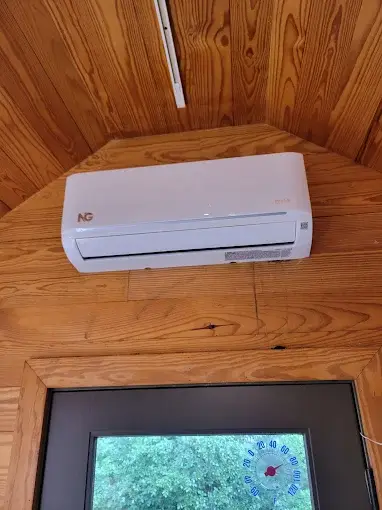
The indoor unit’s filters are washable plastic mesh behind the front panel. Lift the panel, slide them out, rinse with warm water, let them dry completely, put them back. No tools.
A clogged filter restricts airflow across the evaporator coil. The unit works harder for less output, efficiency drops, and — because reduced airflow means a colder coil — you eventually get ice formation, which can damage the system.
Rising electricity bills and gradually declining cooling are far more often a dirty filter than a failing compressor. Technicians see this constantly.
Monthly during cooling season is right for Texas. More often in a garage, a workshop, or a home with pets.
The outdoor unit
The condenser rejects heat to outdoor air, and it needs airflow to do it.
Keep three feet clear in front of the coil and above the unit. The most common obstruction is a shrub that has grown in over two seasons.
Clear debris seasonally. Leaves, grass clippings, cottonwood fluff, and pine straw pack into the coil fins. On wooded lots — The Woodlands, Hill Country acreage, older East Texas neighborhoods — check every few months rather than annually.
Rinse the coil gently with a garden hose from the inside out if you can access it, with the power off at the disconnect. Never use a pressure washer: it bends the fins flat and permanently reduces capacity.
Do not build an enclosure. Homeowners occasionally box in a condenser for appearance. A unit that recirculates its own hot discharge air loses substantial capacity. Screening with airflow gaps is fine; enclosure is not.
Condensate drainage in Texas
Worth its own section, because Texas humidity makes it a bigger deal here than in dry climates.
A mini split working in Houston humidity produces a genuinely large volume of water. That water leaves through a drain line running from the indoor unit, usually through the wall penetration alongside the refrigerant lines.
Check the flow twice a year. During operation on a humid day, water should be exiting the drain outlet outdoors. No water on a humid day means a blockage.
Watch for algae. The drain line is dark, wet, and warm — ideal for biological growth. A slime blockage backs water up into the indoor unit, which then runs down your interior wall. This is the most common mini split callback in humid parts of Texas.
Where a condensate pump is used — when gravity drainage is not possible — it has its own failure mode. Pumps have float switches that stick. If your system has one, ask your technician to test it at the annual service.
A blocked drain is inexpensive to prevent and expensive to discover via a stained wall.
What a professional service covers
An annual service should include:
- Deep coil cleaning, indoor and outdoor, with proper coil cleaner
- Refrigerant charge verification. Not just a pressure reading — superheat and subcooling measured against the manufacturer’s spec
- Electrical inspection. Connections loosen with thermal cycling; a loose lug is a fire risk
- Drain line flush and treatment
- Blower wheel inspection. These accumulate a film that unbalances the wheel and cuts airflow
- Operating measurements — temperature split across the coil, amp draw against nameplate
- Defrost cycle check in heating mode
Expect $120 to $250 for a single-zone system, more for multi-zone.
A note on refrigerant: a properly installed sealed system does not consume refrigerant. If a technician says you are low, the correct response is to find and repair the leak, not simply add more. A contractor who tops off a system annually without ever locating a leak is charging you for a problem they are not fixing.
Warning signs worth a call
Ice on the indoor coil or refrigerant lines. Turn the system off and let it thaw. Causes are low airflow (dirty filter — check that first), low refrigerant charge, or a failing blower. Running an iced system damages the compressor.
Water dripping from the indoor unit. Almost always a blocked drain. Address quickly — this is a drywall and mold problem within days.
Sharply rising bills with no change in usage. Filters first. Then coil condition. Then a service call.
Longer runtime for the same comfort. Gradual capacity loss usually means a dirty coil or a slow refrigerant leak.
New noises. Rattling is often a loose panel or debris in the outdoor fan. Grinding or a hard hum at startup suggests a compressor or capacitor problem and warrants prompt attention.
Musty smell when it starts. Biological growth on the indoor coil or blower wheel. Needs a professional deep clean, not a spray.
Frequent defrost in mild weather. Normal in cold damp conditions; abnormal at 50°F.
What actually determines lifespan
Ranked by influence:
1. Installation quality. By a wide margin. A system that was properly evacuated, correctly charged, and correctly sized will outlast a better-branded unit that was not. Moisture left in the refrigerant circuit at installation forms acids that destroy the compressor over two to five years, and nothing you do afterward reverses it.
2. Correct sizing. An oversized unit short-cycles, and compressor starts cause more wear than running hours.
3. Filter discipline. The cheapest lever you control.
4. Coil cleanliness. A dirty condenser forces higher head pressure, which stresses the compressor continuously.
5. Equipment quality. Real but secondary. Premium equipment has better parts availability a decade out, which matters when something does fail.
Note that the top four are all about installation and upkeep rather than what you bought. This is why the DIY question matters more than brand selection.
Regional notes
Gulf Coast — Houston, Katy, Pearland, Sugar Land. Drainage is the dominant issue. Check the condensate line twice a year without fail, and consider drain treatment tablets.
Coastal areas. Salt air corrodes coil fins. Ask about coated-coil equipment if you are near the water, and rinse the outdoor coil more often.
Wooded lots — The Woodlands, Hill Country. Debris in the outdoor coil. Check quarterly.
West Texas and El Paso. Dust rather than humidity. Filters clog faster; drainage is rarely an issue.
North Texas. Check the outdoor unit after freeze events, and clear any snow or ice accumulation. Never chip ice off the coil.
Next steps
For what a system costs to run — and how maintenance affects it — see running costs. For installation quality and why it dominates lifespan, see DIY vs professional installation.
About the author
John Zoch
John Zoch is a partner at Get Mini Split Quotes, the veteran-owned Houston company that matches Texas homeowners with TDLR-licensed, EPA-certified ductless installers. He works with homeowners and licensed installers across 28 Texas cities, from Gulf Coast humidity problems to Panhandle-edge freeze performance. He writes about what ductless systems actually cost and, just as often, where they are not the right answer.
Published . Last updated . Pricing and program information change — figures are current as of the last update and are estimates, not quotes.
Keep reading
- Texas Mini Split Cost Guide 2026
What ductless mini split installation actually costs in Texas in 2026 — single-zone through whole-home, plus the line items that move the number.
- What Size Mini Split Do I Need? A Texas Sizing Guide
How many BTUs you need by room size, the Texas factors that move that number 30–50%, and why oversizing is the more expensive mistake in Gulf Coast humidity.
- Do You Need a Permit for a Mini Split in Texas? City-by-City Guide
Yes, most Texas cities require a permit for a mini split. What each permit covers, what the inspector checks, and the rules in all 28 Texas cities we serve.